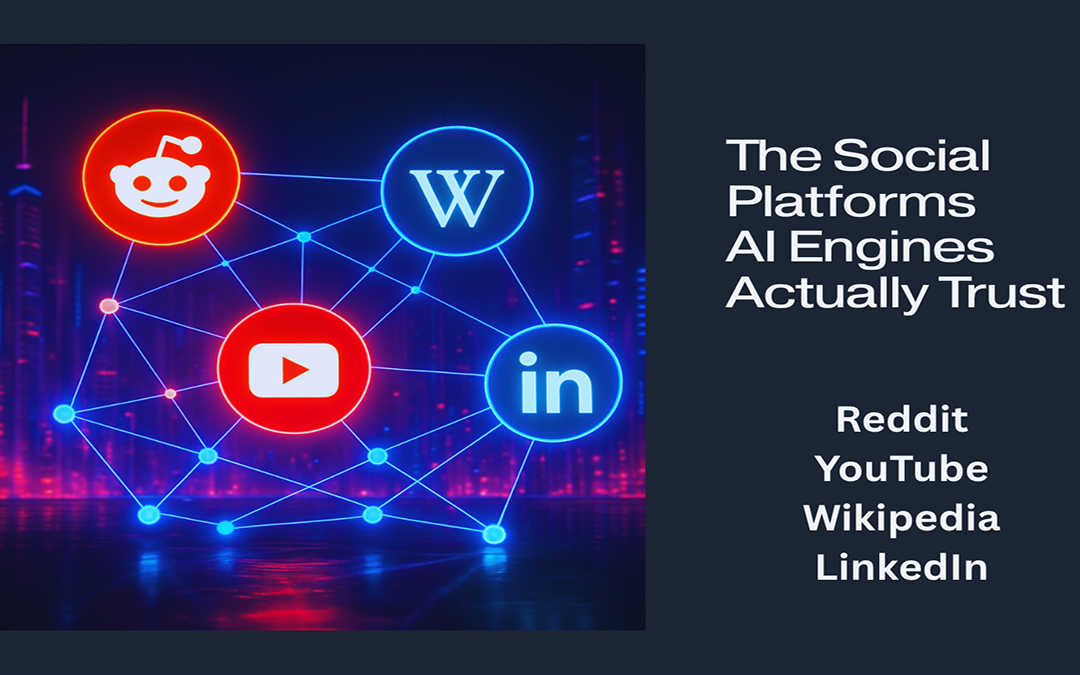
Bottom line: If you want to show up when a prospect asks ChatGPT, Perplexity, or Google’s AI Overviews for a recommendation, four platforms carry most of the weight — Reddit, YouTube, Wikipedia, and LinkedIn. Everything else is a corroboration layer: useful for confirming you’re a real, consistent entity, not for getting you cited.
Here’s the full breakdown by tier, based on 2026 citation data.
Tier 1 — cited across nearly every engine
Reddit is the single most-cited social source. It’s Perplexity’s #1 source, accounting for 46.7% of its top-10 sources, and it ranks at or near the top for ChatGPT as well. Real people answering real questions in threads is exactly the kind of material these engines want to quote.
YouTube is Perplexity’s second-heaviest source at 13.9%, and it carries strong extraction value across the board. The engines read the transcript, not the view count — what gets said in a video matters more than how many people watched it.
Wikipedia is ChatGPT’s dominant source, supplying somewhere between 26% and 48% of its top citations. If your organization has a legitimate, notable entry, it’s a significant asset. Most small, specialized retail shops or firms won’t qualify — and you should never manufacture one.
LinkedIn is less a citation source than an identity anchor. It’s where AI systems confirm your firm and your people are who you say they are, through the sameAsA schema.org property that links your entity to its verified profiles elsewhere (LinkedIn, X, Wikipedia), so search engines and AI can confirm they all refer to the same organization. link in your Organization schema.
Tier 2 — the trust layer, not primary citation drivers
These don’t get you cited on their own. They corroborate that you’re real and consistent.
- Quora — a Q&A and community trust signal, similar in role to Reddit but smaller in reach.
- X / Twitter — entity verification through
sameAsA schema.org property that links your entity to its verified profiles elsewhere (LinkedIn, X, Wikipedia), so search engines and AI can confirm they all refer to the same organization., plus a brand-consistency signal. - G2, Capterra, Trustpilot — independent confirmation that your claims hold up. AI treats these as a corroboration layer, not a primary citation.
What actually matters for social platforms
Three things separate the firms that show up from the ones that don’t:
1. Entity verification comes first. The sameAsA schema.org property that links your entity to its verified profiles elsewhere (LinkedIn, X, Wikipedia), so search engines and AI can confirm they all refer to the same organization. property in your Organization schema — linking to verified LinkedIn and X/Twitter profiles — is how AI systems confirm your identity. Get this right before worrying about anything else.
2. Brand mentions beat engagement. Ahrefs analyzed 75,000 brands and found that branded web mentions correlate with AI visibility at 0.664–0.709, while backlinks sat below 0.30. Follower counts and likes don’t move the needle — social engagement metrics aren’t direct AI trust signals the way editorial citations and structured data are. Being talked about matters more than being followed.
3. Weighting differs by engine. ChatGPT favors encyclopedic, recognizable sources like Wikipedia and Reddit. Perplexity skews toward recency and specialized sources over high-authority generalists. There’s no single formula that satisfies every engine at once.
The takeaway
You don’t need to be everywhere. You need to be verifiable and consistently mentioned in the few places AI actually reads. For most professional firms, that means three moves in order: lock down entity verification with correct sameAs schema, earn genuine mentions in the platforms your prospects use to ask questions, and stop chasing follower counts that AI ignores.
That’s the diagnostic question worth answering: when an AI engine tries to confirm who you are, can it — and does what it finds match? If you’re not sure, that’s exactly the gap an AI-visibility audit is built to find.