A firm can have four hundred five-star reviews, twenty years in practice, and a fast, clean website — and still never be named when someone asks an AI assistant to recommend a firm like it. The reason usually isn't quality, content, or even ranking. It's that the machine isn't sure the firm is a single, specific thing.
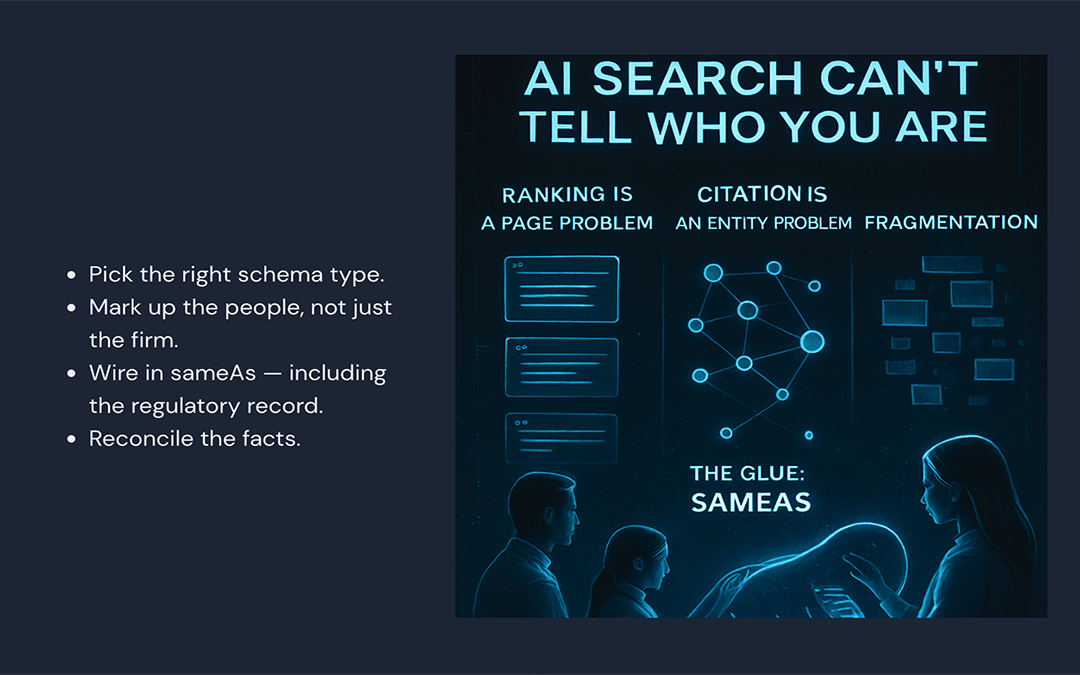
Ranking is a page problem. Citation is an entity problem.
Traditional SEO asks a question about pages: does this page deserve to rank for this query? AI answer engines ask a question about things: which businesses are real, which ones do this kind of work, in this place, and which do I trust enough to name?
That second question is answered by an entity graph, not a page index. And the engines have a strong, well-documented bias here: AI answers preferentially cite entities they already recognize. Recognition is the gate. Everything else is downstream of it.
Which means the most valuable work in AI visibility often isn't writing another article. It's making sure that when an engine encounters your name in nine different places, it concludes those are all the same business.
What "fragmentation" actually looks like
Here's a composite of what we routinely find, drawn from real audits:
- The website says four attorneys. One directory says two. Another says three.
- The site publishes one phone number. The firm's Instagram uses a different vanity line.
- Google shows a 4.9 rating from six hundred reviews. A legal directory shows 2.6 from a handful.
- An aggregator has auto-generated a description from scraped data and filed a dedicated real-estate practice under general litigation.
- The firm's own website gives a different office count depending on which page you're reading.
To a person, this is untidy. To an engine trying to resolve many signals into one confident picture, it's disqualifying. The signals don't accumulate into authority — they cancel out. The firm isn't invisible because it's absent. It's hard to name because it contradicts itself.
There's a nastier version. If a similarly named business operates nearby — a same-surname attorney two miles away, a national agency using your brand's words — the engine may quietly merge you. Whatever is said about them can end up attached to you, and you'll never see it happen.
The glue: sameAs
Schema.org gives you a property whose entire job is to say "the thing on this page is the same thing as the thing at these other URLs." That property is sameAs, and it's the single highest-leverage element in most entity work.
An Organization node with a sameAs array pointing at your Google Business Profile, your LinkedIn company page, your listing on the directory your industry actually uses, and — best of all — the authoritative regulatory record for your license, tells the engine: these nine profiles are one business. Without it, they're nine strings that happen to look similar.
Most of the professional websites we audit have no sameAs at all. Some have social icons in the footer that link to real profiles, but as plain images — invisible to the entity graph. The information is right there on the page, and structurally worthless.
The four things worth fixing, in order
1. Pick the right schema type. Not generic LocalBusiness or, worse, nothing at all. Attorney or LegalService. RealEstateAgent. FinancialService. AccountingService. The type is the engine's first clue about what category of answer you belong in.
2. Mark up the people, not just the firm. A Person node per professional, with hasCredential (the bar admission, the CPA, the CFP), memberOf, alumniOf, knowsAbout, and areaServed. In regulated fields especially, the humans carry the trust.
3. Wire in sameAs — including the regulatory record. The state bar member directory. The SEC's IAPD or FINRA's BrokerCheck. The state licensing board. These are records engines treat as ground truth, and almost nobody links to them. It's free credibility sitting unused.
4. Reconcile the facts. One phone number. One address format. One count of how many people work there. One list of what you actually do. Everywhere — site, Google Business Profile, every directory. This is the least glamorous item on the list and usually the most valuable.
Why this compounds
Branded searches make up roughly 44% of Google queries, and they still reliably send clicks in an era when most searches send none. Meanwhile, the AI engines reach for entities they already know. Both of those facts point the same way: becoming a name the machines recognize is the asset. It survives algorithm changes, channel churn, and whatever gets shipped next quarter.
You cannot buy that. You build it by being consistent, everywhere, until the graph has no reason left to doubt you're one specific, real, findable business.
A note on honesty
None of this is a ranking guarantee, and any firm promising you one is guessing. Entity grounding doesn't force an engine to name you. It removes the reasons it currently has not to. That's a real and measurable difference, and it's the one we can actually diagnose.
Curious what the engines currently believe about your firm? That's the GEO audit. Or see the whole method.
Branded-search share and the observation that AI answers favor recognized entities: SparkToro, 2026. Schema.org property definitions per schema.org. Findings described here are composited from real audits and contain no identifying client detail.